Google does not decide whether a page ranks by running it through a single algorithm. The company employs thousands of quality raters who manually review pages every week using a detailed rubric called the Search Quality Rater Guidelines. That 170-page document describes exactly what a high-quality page looks like versus a low-quality one, and the central framework it uses is E-E-A-T: Experience, Expertise, Authoritativeness, and Trustworthiness.
These ratings do not directly change your rankings. What they do is train the machine learning systems that do the actual ranking. When raters consistently mark a category of pages as high or low quality, those patterns become detectable signals. This is why E-E-A-T is not a single ranking factor you can fix in 10 minutes. It is a description of patterns that correlate with genuine quality, and it applies to every page you want to rank.
This guide is organized around all four components. For each one, you will find what Google is specifically looking for, how to check whether your pages have it, and what to fix if they do not.
Experience: The Signal AI Cannot Generate
Google added the first "E" for Experience in December 2022. The timing was not coincidental. AI-generated content had become sophisticated enough to demonstrate expertise it did not actually have. A language model can explain how to diagnose a failing hard drive in technically accurate terms. A person who has actually done it writes differently: they mention the specific model of screwdriver that strips the screws, the cable that is always in the way, the diagnostic tool that gives false positives 30 percent of the time.
Experience signals are first-person, specific, and unpolished in ways that text produced from training data is not.
What Experience Looks Like on a High-Ranking Page
Original images and media. Screenshots you took yourself, photos of the actual situation you are describing, or data you collected and visualized. A plumber's article about drain cleaning that includes photos from an actual job reads completely differently from one that uses a stock image of a wrench. Google's systems can distinguish between pages with genuine original media and pages using generic illustrations. Stock images do not signal experience.
Precise, contextual details. Generic advice can be reproduced from any source. Experience shows in specifics that apply only to a particular context: "this only applies if your WordPress site uses a child theme," or "I ran this test across 14 different pages over 90 days and found that the third approach outperformed the others by 22 percent." Advice that could apply to any situation in any context signals that nobody with direct experience contributed to it.
Honest limitation and failure documentation. Practitioners who have done something describe what did not work, what edge cases exist, and when a different approach is required. Pages that describe everything as working smoothly, with no failure modes or exceptions, do not read as experience-based writing.
Named, attributable authorship. Every article should have an identifiable author, a real byline, an author page with professional background, and writing that reflects a specific person's perspective. "The ToolsNest Team" with no individual name attached is a weaker experience signal than a named person with an author page describing their work. The difference matters most in competitive niches where Google is comparing dozens of similar pages.
For SEO content specifically, experience signals include describing actual results from actual websites with specific numbers: "after fixing the canonical tags on 40 product pages, the indexed page count in Google Search Console increased from 18 to 37 within six weeks." That sentence cannot be generated by a model that has never touched a live website.
How to Add Experience Signals to Existing Content
If your pages lack experience signals, the changes are specific and doable:
- Add a named author to every article you want to rank. Link to an author page that describes their professional background in the subject area.
- Add a first-person account section to existing guides, even if brief. Describe what you actually did, what happened, and what surprised you.
- Replace stock images with original screenshots. If an article discusses using the free SEO audit tool, include a screenshot of an actual audit result from a real site, not an illustration.
- Add a "what did not work" or "common mistakes" section that documents failure cases and limitations you have personally encountered.
Expertise: Depth That Signals You Know More Than the Average Reader
Expertise is about knowledge depth, not credentials. A mechanic who dropped out of school but has rebuilt 300 engines has more automotive expertise than a mechanical engineering PhD who has never touched a car. Google does not require formal qualifications. It requires evidence that the author knows the topic at a level above what any reader could find by searching for two minutes.
Signals Google Uses to Evaluate Expertise
Coverage of subtopics and edge cases. A page that covers only the obvious questions any searcher would already know to ask does not signal expertise. A page that addresses the questions a beginner would not think to ask, explains why common approaches fail in specific scenarios, and covers the edge cases that separate a novice from a practitioner does.
Accurate technical vocabulary. Experts use terms precisely. A page about SEO audits that uses "meta description" when it means "title tag" signals inexpertise immediately. Correct, specific vocabulary, used without excessive jargon, is the signal to aim for.
Primary source citations. Experts in any field know where the authoritative sources are. An SEO article that cites Google's Search Quality Rater Guidelines, Google Search Central documentation, or specific algorithm update announcements by name reads as more authoritative than one that references only other blog posts.
Topical authority across the full site. A single strong article does not establish expertise. A site that covers an entire topic cluster, with individual pages each handling a specific subtopic in depth, signals that the site is a genuine resource rather than a one-off piece. This is why the learn section of a well-structured SEO site contributes to authority building across the whole domain. A site with 15 tightly related articles on technical SEO, on-page optimization, keyword research, content strategy, and link building signals more expertise than a site with one general guide and nothing else.
Building Topical Expertise Systematically
The most reliable path to expertise signaling is topic clusters. Pick a core subject and create:
- A comprehensive pillar page that covers the topic broadly, linking out to each major subtopic.
- Supporting pages for each major subtopic, each deep enough to fully answer that subtopic's specific questions.
- Internal links connecting every supporting page to the pillar and from the pillar to every supporting page.
For an SEO tools site, a practical cluster looks like this: a pillar page on on-page SEO with supporting pages covering title tags, meta descriptions, heading structure, content optimization, keyword density, and internal linking. The keyword density checker links from the keyword density supporting page. The meta tag generator links from the title and meta description pages. Every page reinforces every other page's topical relevance.
Authoritativeness: What Others Say About You
Authoritativeness is the one E-E-A-T component you cannot directly control. It is built through external recognition: who links to you, who mentions your brand, who cites your research, and whether other authoritative sites in your space treat you as a legitimate resource.
How Authority Builds at the Page and Domain Level
Editorial backlinks. A link from a page that genuinely mentions your content as a useful resource, with surrounding text explaining why, is worth more than 20 links from low-quality directories. Quality raters look specifically at whether high-quality external sites have cited the page. For new sites, a handful of editorial links from respected industry publications outweighs hundreds of forum posts or directory submissions.
Unlinked brand mentions. Google's systems detect brand mentions even without a hyperlink. When other sites reference your tool or content by name in a relevant context, it contributes to brand entity recognition. Being genuinely useful is the most efficient authority-building strategy because useful tools and guides get mentioned by people who found them helpful, without any outreach required.
Author-level entity recognition. If your authors have published on other respected sites, spoken at conferences, or been interviewed by industry publications, that external record contributes to their authoritativeness as an entity. This matters most for YMYL topics but applies to any competitive niche.
Internal authority distribution. High-authority pages on your own site pass trust to other pages through internal linking. A deeply authoritative guide on technical SEO that links to your website speed checker and your robots.txt generator passes topical authority to those pages. This is why internal linking is not optional maintenance. It is the primary mechanism by which authority you have already earned reaches pages that need it.
The Realistic Authority-Building Path for New Sites
New sites cannot compete on brand authority immediately. The practical path:
- Build a topic cluster that is more comprehensive than any competitor in one specific niche. Be the definitive resource on a narrow topic before trying to rank for broad ones.
- Create one original research asset per year. A survey, a controlled test with published methodology and results, or a dataset. Other sites will cite it, and citations build authority faster than almost any other organic approach.
- Contribute guest articles to respected sites in your niche. A bylined article on a site your target audience already reads builds author entity recognition that transfers back to your domain.
- Run regular SEO audits on the pages you are building authority around. Weak on-page signals limit how far authority can carry you in rankings even when you have it. The free SEO compare tool shows how your on-page signals stack up against specific competing pages, which makes it easier to identify the exact gaps holding you back.
Trustworthiness: The Foundation Every Other Signal Depends On
Trustworthiness is the most important E-E-A-T component because it is binary in a way the others are not. A page can have limited experience or modest expertise and still rank if it is clearly trustworthy. A page that is untrustworthy does not rank well regardless of how strong its other signals are.
Accuracy and Factual Integrity
Pages containing false or misleading information receive the lowest possible quality ratings from Google's raters regardless of other signals. For SEO content, this means:
- Claims about how Google's systems work should cite Google's own documentation or be clearly labeled as interpretation, not fact.
- Data should have sources.
- Advice should not contradict what Google has publicly stated in its Search Central documentation or blog posts.
For YMYL topics, health, financial, and legal advice specifically, accuracy is evaluated under much stricter standards than for general informational content. Wrong information in those areas causes real harm. Google's systems reflect this with stricter quality thresholds.
Transparency Signals
Clear authorship, a working contact method, a genuine about page, and an accessible editorial policy are transparency signals that quality raters check directly. Pages that cannot be attributed to a real person or organization receive lower trust ratings by default.
The transparency structure that supports site-level trust includes an about page describing what the site is and who runs it, an author page describing who creates the content, an editorial policy describing how content is produced and maintained, a security page explaining how user data is handled, and a contact page with real email addresses. These do not directly boost rankings on individual pages. They establish the site-level trust that informs how every page on the domain is evaluated.
HTTPS as a Trust Baseline
HTTPS is a foundational trust signal. Its absence is a clear negative. Any page still served over HTTP in 2026 signals that basic security hygiene has been skipped, which degrades trust signals across the entire domain.
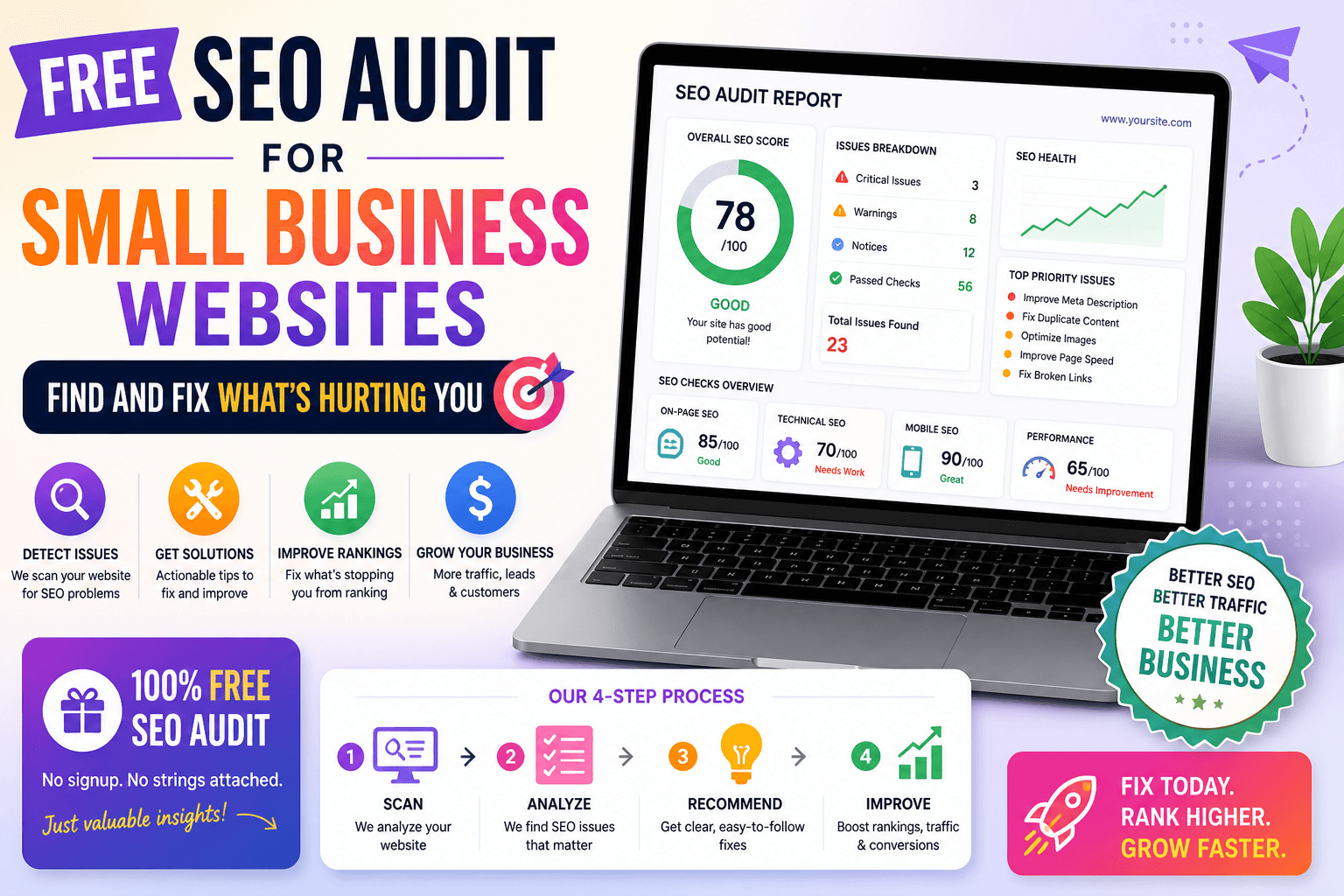
The more practical check is whether your HTTPS is configured correctly beyond just having a certificate. Canonical tags, sitemap entries, and internal links should all use HTTPS URLs consistently. Mixed content, meaning an HTTPS page loading HTTP resources like images or scripts, triggers browser security warnings that reduce user trust even when a certificate is in place. The free SEO audit tool checks HTTPS status, canonical configuration, and other technical trust signals on any page in a single scan.
Content Maintenance and Freshness Signals
A page with a publication date of 2020 and no updated date is implicitly claiming that years-old information is still current. For SEO and technical topics, that claim is almost always false. Quality raters note when content appears outdated relative to its subject matter.
Practical maintenance:
- Add a visible "Last Updated" date to any content page and update it when you revise the content.
- Review published guides once per year for accuracy. Remove advice that no longer applies. Add new context where relevant.
- For evergreen technical guides, note the specific update date in the article body, not only in the metadata.
YMYL: When E-E-A-T Requirements Are Strictest
YMYL stands for Your Money or Your Life. Google's quality raters apply the strictest E-E-A-T standards to pages in this category because wrong information in these areas causes direct harm. YMYL includes:
- Health, medical, and safety information
- Financial, investment, and legal advice
- Pages covering government policy or civic information
- News covering ongoing events with public health implications
For sites in these categories, solid E-E-A-T is not sufficient on its own. Google's guidelines explicitly state that some YMYL content requires formal credentials: medical advice should come from medical professionals, legal advice from attorneys, financial advice from qualified financial advisors. "Editorial team" attribution without named credentials is evaluated significantly lower for YMYL content than for general informational content.
If your site covers YMYL topics, the E-E-A-T requirements you face are substantially more demanding than what applies to a general tools or educational site. The non-YMYL guidance in this article is accurate for most content. YMYL publishers should read the full Search Quality Rater Guidelines directly, available on Google's website.
Running an E-E-A-T Audit on Your Own Pages
The practical way to apply E-E-A-T to existing content is a structured page review against specific checkpoints.
Experience signals
- Does every article have a named individual author, not a generic editorial team attribution?
- Does the author page describe real professional background in the subject area?
- Does the content include original media (screenshots, photos, charts) rather than stock images?
- Does the writing include specific details that could only come from direct experience?
- Are failure cases, limitations, and exceptions documented?
Expertise signals
- Does the page cover subtopics and edge cases that a beginner would not think to ask about?
- Are technical terms used accurately and consistently throughout?
- Are claims referenced to primary sources where available?
- Does the site have a cluster of related content around this topic, or is this an isolated page?
Authoritativeness signals
- Do other sites in the niche link to this page editorially?
- Has the author published or been cited outside this site?
- Is this page linked from other authoritative pages on your own site?
Trust signals
- Is every factual claim accurate? Would a subject expert challenge any statement on the page?
- Is there a working contact method on the site?
- Are there a genuine about page and editorial policy?
- Is HTTPS configured correctly with no mixed content warnings?
- Are publication and last-updated dates visible and accurate?
For the technical signals in this checklist, the free SEO audit tool handles verification automatically across 18 on-page and technical factors. Content quality signals require human review. The readability checker helps evaluate whether your writing is clear and accessible at the right level for your intended audience. The two together cover most of what a practical E-E-A-T audit involves.
What E-E-A-T Is Not
Several persistent misconceptions cause SEO practitioners to waste time on things that do not move the needle.
E-E-A-T is not a direct ranking signal. It describes the characteristics of high-quality pages that tend to rank well. You cannot add an E-E-A-T score to a page. You cannot install a plugin that improves it. You improve it by being genuinely more trustworthy, knowledgeable, and authoritative.
Structured data does not directly improve E-E-A-T. Schema markup helps Google understand page structure and enables rich results in search. It does not make a page more authoritative. Adding AuthorSchema to an article written entirely by AI and unreviewed by a human does not signal real expertise.
Social media following is not authoritativeness. 50,000 Twitter followers do not establish you as an authority in Google's framework. What matters is whether sites that Google already considers authoritative have cited you.
More content is not more expertise. Publishing 200 articles in three months signals the opposite of topical expertise if none go deep. One 3,500-word, thoroughly researched guide on a specific topic builds more authority than ten thin 300-word posts covering loosely related topics.
The Compounding Effect of Getting E-E-A-T Right
E-E-A-T improvements compound in a way that most SEO fixes do not. Adding experience signals makes content more useful, which earns more links. More links increase authority, which helps every page on the site. Better trust signals reduce bounce rates, which improves behavioral signals. Every component reinforces the others over time.
The practical prioritization for most sites:
- Fix trust signals first. HTTPS, named authorship, about page, contact page, editorial policy. These are fast, foundational, and required before other signals can function properly.
- Fix experience signals on highest-traffic content. Named authors, original media, specific contextual details. This is medium-speed work with clear outcomes.
- Build expertise through topic clusters. Connect existing content into coherent clusters. Fill visible gaps with new, deep supporting pages. This is the work that takes longest and has the biggest long-term payoff.
- Let authority accumulate as the result of the first three. You cannot shortcut the external recognition component, but you can make sure your internal signals are not holding it back.
For sites already doing the basics right, the next step is a systematic content audit of every published page. The free SEO audit tool covers the technical layer. The content quality review requires you to check each page against the experience and expertise signals above. The pages missing those signals are the first to improve.
FAQ
What is E-E-A-T in SEO? E-E-A-T stands for Experience, Expertise, Authoritativeness, and Trustworthiness. It is the framework Google's quality raters use to evaluate whether a page deserves to rank highly. The first "E" for Experience was added in December 2022 specifically because AI-generated content had become sophisticated enough to fake expertise but could not fake direct firsthand experience. E-E-A-T is not a direct ranking signal. It describes the quality patterns that Google's machine learning systems are trained to recognize and reward in search results.
How do I improve E-E-A-T on my site? There is no E-E-A-T score to optimize. You improve it by making your content genuinely better in each component. Add named authors with professional backgrounds and real author pages. Include original research and first-person experiential details. Build topic clusters to demonstrate expertise. Earn editorial backlinks by publishing content worth citing. Maintain accurate, current content with clear transparency signals. Run an SEO audit on your key pages to identify technical trust issues that are fast to fix and often suppressing rankings silently.
Does E-E-A-T apply to all pages or only YMYL? E-E-A-T applies to all pages, but the standards vary significantly by topic. YMYL topics (health, legal, financial advice) face the strictest requirements and may require formal credentials for individual authors. For general informational content, the bar is lower: a well-researched, author-attributed, accurate page with clear site-level transparency and solid internal linking can demonstrate adequate E-E-A-T without formal credentials in the subject area.
Can AI-generated content rank if it has good E-E-A-T? AI-generated content can rank if it is accurate, useful, and has been reviewed or substantially contributed to by a person with real expertise in the topic. The issue is not whether AI was involved. The issue is whether the content demonstrates genuine experience (which AI cannot have), real expertise (which requires human contribution), and clear authorship by an identifiable person. AI content published without human review or individual attribution fails the experience signal that Google specifically added E-E-A-T to evaluate.
How long does it take to see E-E-A-T improvements reflected in rankings? Technical trust signals (HTTPS, authorship markup, accurate metadata) can affect rankings within weeks after Google recrawls your pages. Content quality improvements take two to three months to show results in most cases. Authority accumulates over 12 months or more and cannot be rushed. The fastest wins come from fixing trust signals first, which removes barriers and allows the content quality signals you already have to work more effectively.